
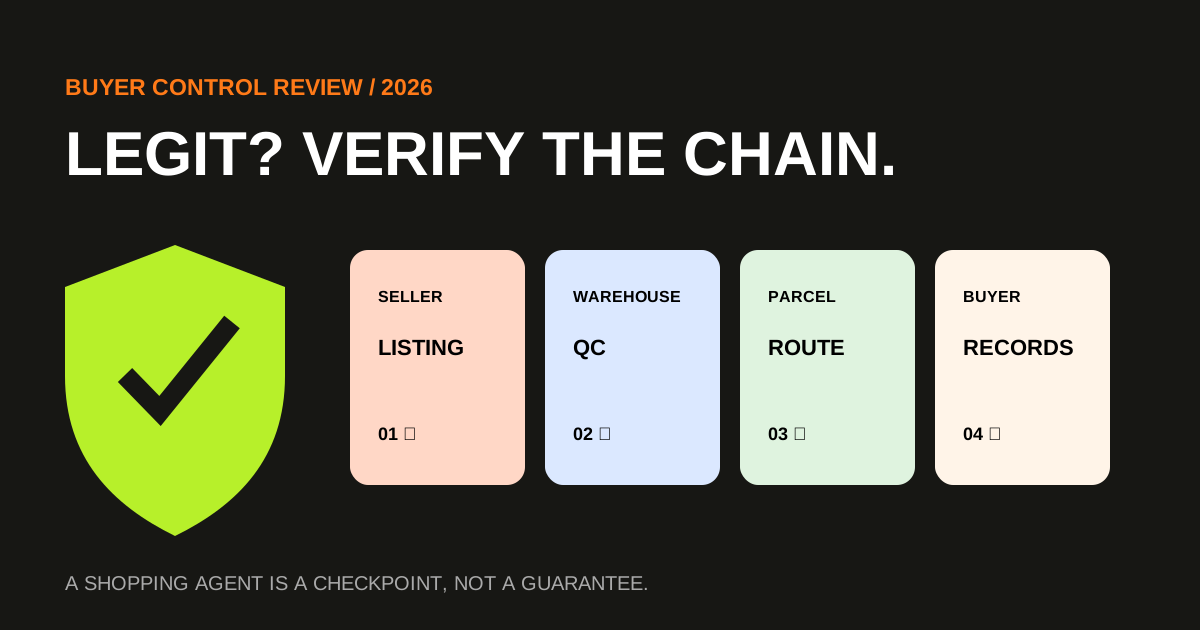
Sugargoo presents itself as a China shopping and shipping agent that purchases from marketplaces, receives goods at a warehouse and offers international logistics. Its public site, account system and mobile app describe support for platforms such as Taobao, Weidian and 1688, warehouse QC and shipping to many destinations. Those are signs of an operating service. They do not make every seller, product or parcel outcome safe.
1. Answer legitimacy and safety as two different questions
Legitimacy asks whether the service exists and performs the advertised intermediary role. Safety asks how much loss remains possible in a particular transaction. Marketplace sellers can misdescribe goods, size charts can be wrong, photographs can miss hidden defects, carriers can delay parcels and customs can restrict imports. A responsible review therefore evaluates the chain rather than issuing a simple universal verdict.
2. Understand what a shopping agent controls and what it does not
A purchasing agent can place an order using your selected link and variation, receive the seller's parcel, create warehouse records, provide visual checks and prepare an international parcel. It does not manufacture the product or write the seller's listing. It cannot guarantee authenticity, material composition, long-term durability, perfect sizing, customs clearance or carrier performance. These limits are not unique to one agent; they follow from the cross-border purchasing model.
Keep responsibilities visible. The seller controls the offered item and China-side fulfilment. Sugargoo controls its purchasing, warehouse and parcel services under the terms shown in your account. The logistics provider controls movement under its route rules. Customs applies destination law. The buyer selects the link, confirms the option and accepts residual risk. When something fails, identifying the responsible stage makes the support request faster and more specific.
3. Reduce seller and product risk before payment
Start with the current marketplace page, not a copied photo or an old spreadsheet label. Confirm seller, product title, price, option, quantity and domestic freight. Save the live URL and the option you selected. Watch for multi-product listings where the lowest price belongs to a small accessory. If the page is unavailable, has changed identity or cannot show the required variation, do not rely on the historic row.
Describe the order so another person can execute it without guessing. Include exact colour, size, model and included parts. For manual orders, clarity matters even more because the system may not import structured options. A safe workflow creates evidence before disagreement: screenshot the listing, preserve the option and record the date. This will not force a seller to perform, but it establishes what you asked the agent to purchase.
4. Evaluate payment safety from the current checkout
Use only payment methods and recipient details presented inside the current Sugargoo account or official app. Review the payable currency, handling charge, conversion and final amount that leaves your funding source. A familiar logo does not remove exchange-rate or processor costs. Keep the receipt and the matching order number. Avoid moving a transaction to an unsolicited message, private transfer or copied payment address.
Do not confuse successful payment with successful seller fulfilment. The purchase may still face a price change, stock issue, cancellation or domestic return. Maintain a cost ledger that separates platform balance, committed order value, refund status and the reserve for international shipping. This prevents a returned balance from being mistaken for new savings and keeps the later parcel payment available.
5. Use QC photos as evidence with clear limits
Sugargoo's public information describes warehouse inspection and five free QC photos for agent orders. Use them first to reconcile identity: model, colour, tagged size, quantity and visible accessories. Then inspect measurements, condition and construction relevant to the category. If a decisive field is unseen, request one targeted image or measurement. “Looks good” is not a record; a pass, fail or unseen result for each requirement is.
Photography cannot prove everything. It cannot reliably confirm material chemistry, internal electronics, battery longevity, fragrance composition, authenticity or future durability. A power-on test demonstrates limited function at one moment. Lighting can shift colour, and a hidden side may remain uninspected. Write down residual uncertainty before accepting the item. Safety improves when QC is treated as a checkpoint rather than a warranty.
6. Control return and refund risk while the item is still in China
When QC reveals a mismatch, preserve the order record, warehouse image and a neutral explanation. Open the after-sales path available for that order without spending days collecting irrelevant angles. Seller policy, product type, timing and responsibility influence whether cancellation, exchange or return is available and who pays domestic freight. Read the current case terms instead of assuming every item has the same window.
Track status changes and messages in one timeline. State the remedy you want and the evidence that supports it. “Ordered navy; received black” is actionable. An accusation without an order reference is not. A refund shown as approved may still move through platform balance or the original funding path, so record when it becomes usable. Do not delete the failed order from your ledger; it is evidence for future seller selection.
7. Treat international shipping and customs as a new risk gate
Warehouse acceptance does not end the decision. Build the parcel from current weight, dimensions, attributes and destination. Compare available routes, billable weight, estimated time, tracking, protection and restrictions. Sensitive attributes can reduce choices, while bulky packaging can raise volumetric weight. Choose the route for the actual parcel, not from a review of a different shipment.
Use accurate content descriptions and values that reconcile with your records. No agent can guarantee customs clearance because destination authorities apply the law. Protection can reduce some financial loss, but only under the current scope, limits and evidence rules. Save route terms and package evidence before shipment. If the parcel is valuable, record the unopened delivery so a damage or missing-content claim begins with a continuous evidence chain.
8. Use a buyer-control verdict instead of a blanket promise
A reasonable conclusion is that Sugargoo operates as a shopping-agent service, while any individual order still carries seller, product, payment, carrier and customs risk. The useful question is not “Can anything go wrong?” Something can. Ask whether the remaining risk is understood, documented and proportionate to the value. Start with a small, ordinary order before committing money you cannot afford to lose.
Use a four-check rule: verify the live listing, record the exact order, inspect warehouse evidence and approve the parcel from current terms. Stop when a required fact remains unknown and the downside is material. Keep support communication factual and dated. These controls cannot turn cross-border shopping into a guaranteed retail experience, but they make the decision auditable and reduce the most common preventable losses.
Account security belongs in the same control system. Use a unique password, keep recovery access current and never share verification codes with someone who contacted you unexpectedly. Reach support from the official site or app rather than a link in an unsolicited message. Before approving payment or withdrawal, check the order number, amount and recipient shown in the account. Security tools cannot correct a risky seller selection, but they can prevent an otherwise sound purchase from being compromised outside the order workflow.
Judge support by the evidence path, not only by response speed. A useful case includes one order or parcel number, a short timeline, screenshots and a requested remedy. If a response does not answer the question, restate the missing decision rather than opening several cases with different descriptions. Keep copies of the final resolution and any balance movement. The record helps distinguish a platform error from a seller dispute, carrier issue or rule that was disclosed before payment, which is essential when deciding whether to use the service again. Review the outcome against the original terms, not against an expectation created by an unrelated community post. If you cannot document the possible loss or the remaining budget, reduce the order size until the downside is acceptable for a first transaction and learn from the complete delivery record.
Questions buyers ask after reading this guide
Is Sugargoo a real shopping agent?
Sugargoo operates a website, account system and app describing purchasing, warehouse QC and international logistics. A real service still cannot guarantee every seller or parcel outcome.
Does Sugargoo guarantee product authenticity?
No shopping-agent workflow should be treated as proof of authenticity. QC photos can confirm visible details but not provenance, materials or hidden construction.
Is it safe to pay through Sugargoo?
Use only payment options and recipient details shown in the official checkout, review the final debit and keep the receipt. Never move payment to an unsolicited private channel.
Can I return an item after QC?
Returns depend on timing, seller policy, item type and responsibility. Preserve the mismatch evidence and use the current after-sales path before international shipping.
What is the safest way to try Sugargoo?
Begin with a small, ordinary, non-urgent order. Verify the listing, record the exact variant, review QC and choose shipping from current parcel terms.
Independent research based on Sugargoo's official public service, ordering, warehouse and shipping information reviewed September 17, 2026. Always confirm the current terms shown in your own account before paying or submitting a parcel.